How I use prompts on ChatGPT, Claude and Gemini as an SEO professional.
The Single Prompt Is Dead — Here's What Replaces It
I've spent the last 12 months auditing more than 500 websites. And the clearest pattern I've found? In 2026, typing "write an SEO blog post about X" into ChatGPT is a one-way ticket to Google's spam filter.
The sites winning today aren't using AI as a word processor. They're using it as a strategist, researcher, auditor, and editor — running sequences of targeted prompts across multiple models to do work that used to take an entire agency team.
That's what this guide is. A complete, copy-paste library of the AI prompts for SEO I actually use — organized by workflow, model, and goal. By the end, you'll have a repeatable system for turning ChatGPT, Claude, and Gemini into a senior SEO operation.
Let's get into it.
My SEO Prompt Workflows
Having a library of prompts is your starting point. Building them into agentic workflows is where the real leverage comes from. Here are the three I use on every client project.
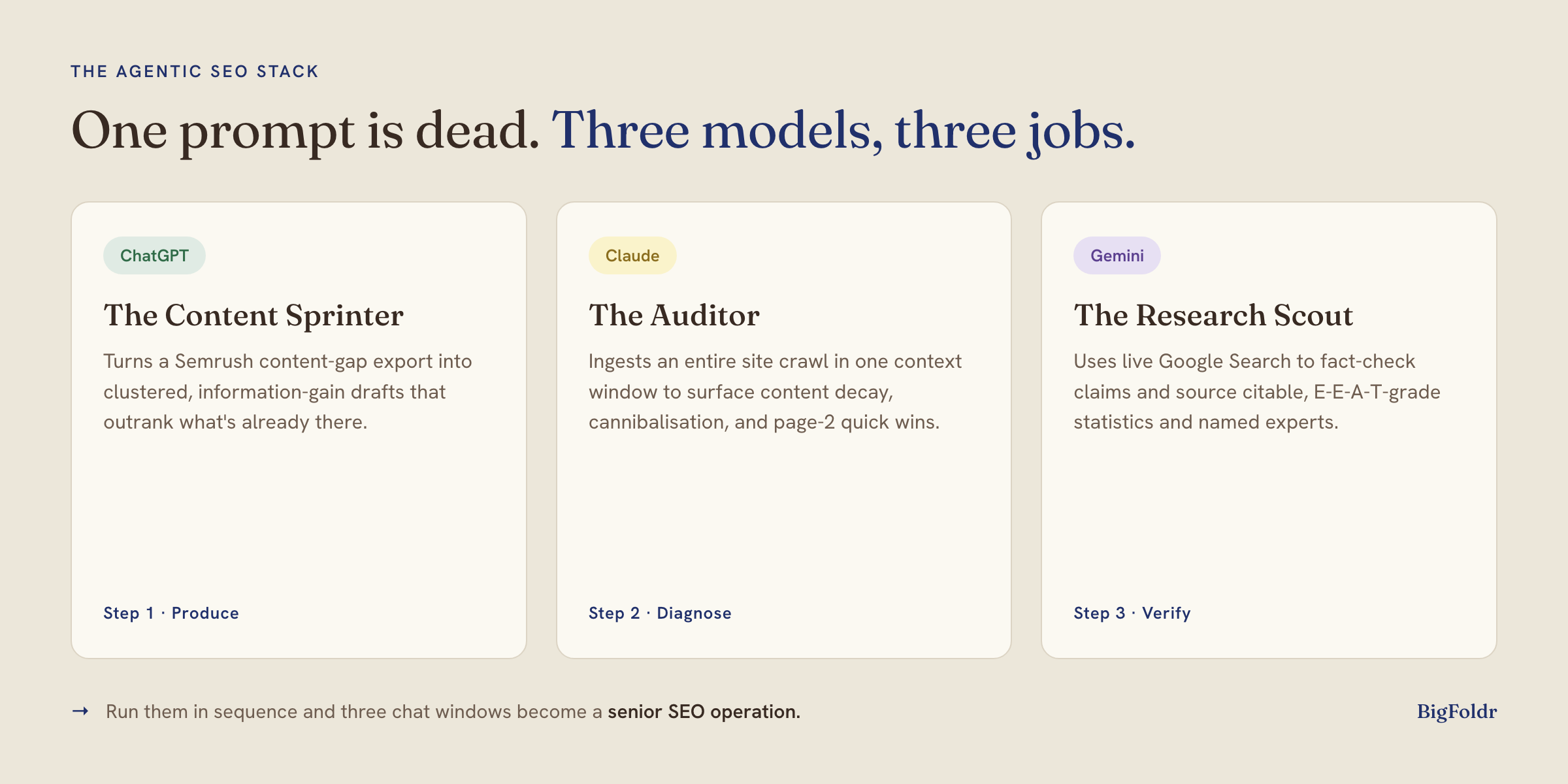
Workflow #1: The Content "Information Gain" Sprint (ChatGPT + Semrush)
This three-step sequence is how I produce content that consistently outperforms what's already ranking.
Step 1 — The Semrush Sync:
I export my Semrush Content Gap report comparing my domain to two or three top competitors. This gives me a list of keywords they rank for that I don't — the raw material for Information Gain content.
Step 2 — The Semantic Map:
"I'm uploading a Semrush Content Gap export. Group these keywords into thematic clusters. For each cluster, identify the primary intent, the best content format, and the 'angle' that would differentiate my article from the top-ranking competitor. Present this as a content calendar-ready table."
Step 3 — The Execution:
"Write a 600-word 'Information Gain' section for an article targeting [Keyword]. The persona is a [Specific Job Title] who has seen the standard advice fail in practice. They should present one contrarian insight, support it with a specific mechanism or example, and pre-empt the most obvious objection."
Workflow #2: AI Prompt Site Audit (Claude)
I use Claude for technical audits because its large context window can ingest massive crawl exports, XML sitemaps, and analytics data simultaneously without losing thread.
My process:
When I start a new engagement, I don't ask for a generic audit. I build a chain.
Prompt 1 — The Decay Finder:
"Act as a Technical SEO Auditor. I am uploading a full site crawl export. Find 5 'pockets of content decay' — clusters of old pages that are cannibalizing newer, higher-quality content in the same topic area. For each pocket, identify the URLs involved and explain the cannibalization mechanism."
Prompt 2 — The Triage Decision:
"Based on the 5 decay pockets you identified, write a one-page strategy memo recommending whether each cluster should be Redirected, Refreshed, or Deleted. For each decision, explain how it affects Link Equity distribution across the site."
Prompt 3 — The Quick-Win Prioritizer:
"From the full audit, identify the 10 pages that are ranking on page 2 (positions 11–20) for a commercially valuable keyword. These are the highest-leverage refresh opportunities. For each page, list the primary issue preventing a page-1 ranking and the single most impactful fix."
Workflow #3: The E-E-A-T Research Scout (Gemini)
Gemini is my fact-checker and authority builder. Its direct connection to live Google Search makes it the best model for sourcing credible, current data to back up content claims.
The Authority Sourcing Prompt:
"Search for the latest 2025–2026 academic papers, government reports, or large-scale industry surveys on [Topic]. Find 3 'power statistics' — figures that are surprising, specific, and highly citable. For each one, provide the source name, the exact URL, and a one-sentence summary of why this statistic elevates the article's credibility."
The Claim Verification Prompt:
"Here are 5 factual claims from my draft article on [Topic]. For each claim, verify whether it is accurate based on current sources. If a claim is outdated or inaccurate, suggest a replacement with the correct figure and source."
The 'Who Said It' Prompt:
"Find 2–3 credible, named experts — academics, published authors, or senior industry practitioners — who have publicly stated a position on [Topic] that supports my article's main argument. Provide their name, title, the quote or paraphrased position, and a source URL."
AI SEO — Optimizing for the Bots Themselves
Here's the layer most SEOs still miss entirely.
If you want ChatGPT, Perplexity, or Google's AI Overviews to cite your content, your text needs to be structurally digestible for their RAG (Retrieval-Augmented Generation) systems. These systems extract information by identifying entity-attribute-value relationships — essentially: what thing, has what property, at what value.
Content that makes these relationships explicit gets cited. Content that buries them in fluffy prose doesn't.
The Citability Optimizer:
"Rewrite this article introduction so that all key Entity-Attribute-Value relationships are explicit. For example: '[Product X] offers [Feature Y] at [Price Z]' rather than vague descriptive sentences. The goal is maximum parseability by AI retrieval systems without sacrificing readability for humans."
The Structured Data Prompt:
"Analyze this article. Suggest the most appropriate Schema.org markup types (e.g., HowTo, FAQPage, Article, Review) and write the JSON-LD code for the top two that would most improve this page's chances of appearing in AI-generated answers and rich results."
The FAQ Schema Generator:
"Based on the content of this article, write 6 FAQ schema questions and answers. Each answer should be 40–60 words — specific enough to be directly useful, short enough to be lifted verbatim by an AI answer engine."
Multi-Modal Prompts (Vision & Data Analysis)
The GSC Trend Analyzer:
"I'm uploading a screenshot of my Google Search Console Performance report. A page that was performing well has shown a sharp decline over the past 60 days. Analyze the trend in the graph. Based on whether CTR or Impressions dropped first, diagnose the most likely cause and suggest 3 meta title variations designed to recover click-through rate."
The Keyword Clustering Agent:
"I'm uploading a CSV of 5,000 keywords exported from Semrush. Use Python to run a K-Means clustering analysis. Group them by search intent into 6–8 distinct clusters. Output a clean CSV with columns for keyword, cluster label, and primary intent. I'll import this directly into my content calendar."
The Heatmap Interpreter:
"I'm uploading a heatmap screenshot from Hotjar showing user behavior on [Page]. Identify where users are dropping off or ignoring key content sections. Suggest 3 structural changes to the page — headings, placement of key claims, or CTA position — to improve engagement and dwell time."
The Competitor Teardown:
"I'm uploading screenshots of the top 3 ranking articles for [Keyword]. Analyze their visual layout, content structure, and apparent word count. Identify the structural pattern they share and then suggest one structural element I could add that none of them include."
Your 2026 SEO Roadmap: Prompts + Workflows + Systems
Here's the honest truth: the prompts in this guide are your raw material. But the compounding advantage comes from turning them into repeatable systems.
The teams and freelancers winning in 2026 aren't using AI to write faster. They're using it to research deeper, audit more rigorously, and find the information gaps that no competitor has bothered to fill.
That's the game. And now you have the playbook.
The immediate next steps:
First, pick one workflow from this guide — the Audit, the Content Sprint, or the E-E-A-T Scout — and run it on your best-performing page from 6–12 months ago. You'll almost certainly find a quick-win refresh opportunity within 30 minutes.
Second, start building your own prompt library. The prompts here are a starting point. The best ones you'll develop will be hyper-specific to your niche, your audience, and the types of Information Gain only your experience can provide.
Third, remember the citability layer. As AI-generated answers take more SERP real estate, the question shifts from "does Google rank me?" to "does AI cite me?" Structuring your content for RAG readability isn't optional in 2026 — it's table stakes.
The era of the single prompt is over. The era of the agentic SEO workflow has begun. You're now equipped for it.